By Analyst Team · Updated 2026-07-18 · 14 min read
If you have ever asked yourself "how does IPTV work" while scrolling past yet another cable bill increase, you are far from alone. Internet Protocol Television (IPTV) has fundamentally reshaped the way millions of households consume live television, sports, and on-demand content. Unlike traditional broadcast methods that rely on satellite signals, coaxial cables, or terrestrial antennas, IPTV delivers programming directly over your existing internet connection — the same one you already use for browsing, streaming Netflix, and video calls.
This complete guide breaks down the technical magic behind IPTV in plain English. We will walk through the step-by-step delivery process, compare it head-to-head with cable and satellite, examine real-world benefits and honest limitations, and guide you to a practical setup whether you own a Firestick, a smart TV, or an Android box. By the end, you will not only understand exactly how does IPTV work — you will know whether it is the right choice for your household and how to get started safely.
[INSERT midCTA HERE]LIMITED TIME AVAILABILITY
Unlock Full how does iptv work Access
Secure special promotional rates instantly before the window closes. Lock in your pricing model today before plans return to standard regional metrics.
What Exactly Is IPTV?
IPTV stands for Internet Protocol Television. Rather than receiving television signals through traditional terrestrial, satellite, or cable formats, IPTV transmits video content as data packets over your broadband internet connection using the same TCP/IP protocol that powers the web. Think of it this way: cable television delivers every channel simultaneously whether you watch it or not, whereas IPTV only sends the specific stream you request at that exact moment. This distinction has profound implications for bandwidth efficiency, channel selection, and interactivity.
There are three primary delivery modes within the IPTV ecosystem. Live television streams broadcasts in real time, much like traditional TV but over the internet. Video on Demand (VOD) lets you select from a vast library of movies and shows to play instantly. Time-shifted media includes catch-up TV, which allows you to watch previously aired programming hours or days after the original broadcast. Many users specifically seek out the best IPTV service for live sports because of the reliability and breadth of international sporting coverage that IPTV platforms can offer.
How Does IPTV Work Step by Step?
Understanding how does IPTV work on a technical level does not require a computer science degree. The process involves four clear stages that happen in milliseconds when you press play on a channel or movie.
1. Content Acquisition and Encoding
The IPTV provider first sources live television feeds or on-demand files from broadcasters, studios, or satellite uplinks. These raw video streams are then encoded into compressed formats such as H.264 or H.265 (HEVC) to reduce file sizes without sacrificing visual quality. The encoding process is crucial because it determines how efficiently the stream travels over the internet and how sharp the picture looks on your screen.
2. Streaming Server and Middleware
Once encoded, the content is stored on powerful streaming servers. These servers are managed by middleware software — the behind-the-scenes system that handles user authentication, Electronic Program Guide (EPG) data, channel lists, and billing. When you log into your IPTV app, the middleware authenticates your subscription and prepares the interface you see on screen. This is also the layer that enables features like parental controls, recording, and multi-device syncing.
3. Content Delivery Networks (CDNs)
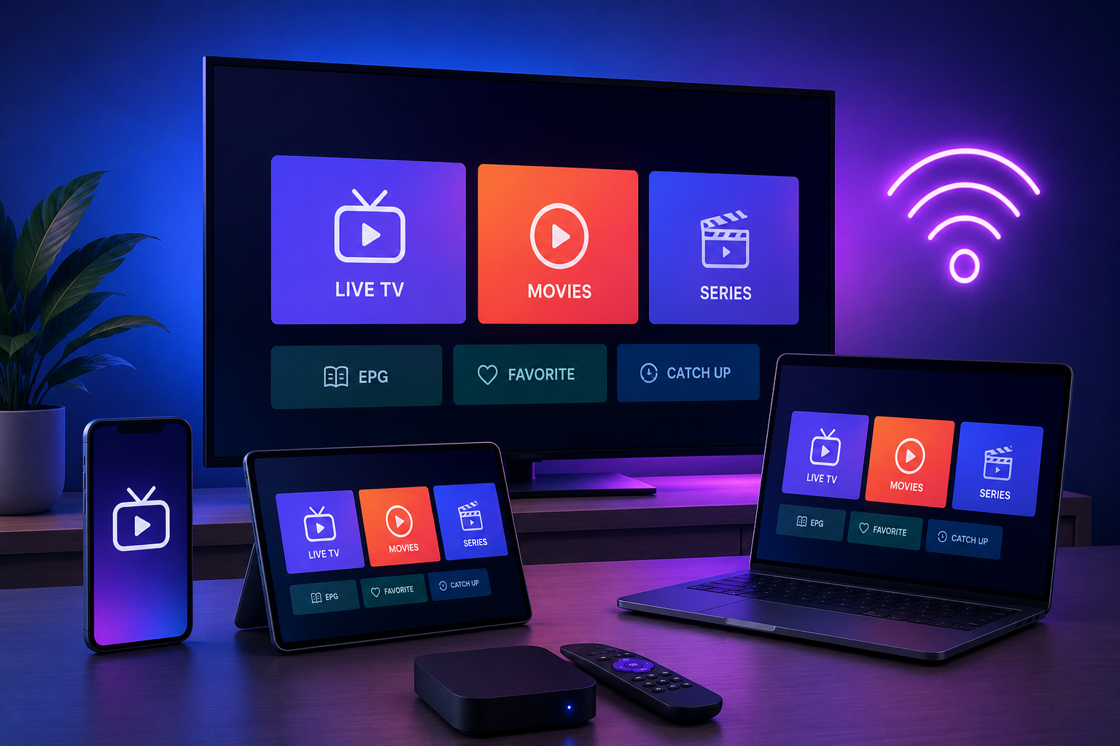
To ensure smooth playback at scale, IPTV providers distribute their streams across multiple Content Delivery Network nodes. If you are in New York, your stream is likely served from a CDN server in the northeastern United States rather than from a central server in Europe. This geographical proximity dramatically reduces latency and buffering. The image below illustrates how a CDN routes your request to the nearest available server.
4. Client-Side Decoding and Playback
On your end, the IPTV app (installed on a Firestick, smart TV, Android box, or smartphone) receives the incoming data packets and decodes them back into a viewable video stream. This decoding relies on your device's hardware capabilities. For example, how to set up IPTV on Firestick involves installing an app like TiviMate or Smarters IPTV Lite, entering your provider's credentials, and letting the app handle the heavy lifting of packet reassembly and playback. A stable internet connection of at least 25 Mbps is recommended for 4K streaming across multiple devices.
Concrete Benefits of Using IPTV
The shift from cable to IPTV is not just about cutting cords — it comes with tangible advantages that improve the viewing experience for most users.
Unmatched channel variety: IPTV subscriptions often include thousands of channels spanning every continent and language. You can watch live football from the English Premier League, Japanese anime channels, Indian news networks, and American primetime dramas — all from a single interface. This is a core reason people search for a best IPTV service for live sports to access leagues that cable bundles rarely carry.
Cost efficiency: Premium IPTV subscriptions typically range from $10 to $25 per month, a fraction of the average $100+ cable bill. Even when factoring in a VPN subscription and high-speed internet, the savings are substantial for most households.
Multi-device flexibility: Unlike cable boxes locked to a single television, IPTV works on smartphones, tablets, laptops, smart TVs, and streaming devices. You can start a movie in the living room and finish it on your tablet in bed without interruption.
Interactive features: Many IPTV platforms include pause, rewind, and record functionality for live TV — features that traditionally required expensive DVR rentals from cable companies. Catch-up TV and extensive VOD libraries further expand what you can watch and when.
Honest Limitations You Need to Know
Transparency matters. While IPTV is a powerful technology, it is not without drawbacks. The most common frustration is buffering. If your internet connection is inconsistent or your provider has weak server infrastructure, you may experience frequent pauses during peak viewing hours. This is why an IPTV buffering fix guide is one of the most searched topics in the community — solutions include switching to a wired Ethernet connection, lowering stream quality, or using a VPN to bypass ISP throttling.
Another consideration is legality. The is IPTV legal in the US question does not have a simple yes or no answer. IPTV technology itself is perfectly legal. However, some providers stream content without proper licensing from broadcasters. Using such services puts you in a legal gray area where you could face service termination from your ISP or potential fines, though enforcement against end-users is rare. Always verify that your IPTV provider operates with proper licensing agreements.
Setup complexity is another barrier. While cable TV requires plugging in a box and turning it on, IPTV demands some technical know-how: installing apps, configuring VPNs, and troubleshooting streams. The learning curve is manageable but real.
✓ Pros
- Significantly lower monthly cost than cable
- Access to 10,000+ international channels
- Watch on any device with an internet connection
- Advanced features like pause, record, catch-up TV
- No long-term contracts or hidden fees
✗ Cons
- Requires stable high-speed internet (25+ Mbps)
- Legitimate services still limited in some regions
- Potential buffering during high-traffic hours
- Technical setup can be confusing for non-tech users
- Quality varies drastically between providers
IPTV vs Cable vs Satellite: Which Is Better?
The IPTV vs cable which is better debate depends heavily on your priorities — budget, channel selection, reliability, and technical comfort. The comparison table below summarizes the key differences.
| Feature | IPTV | Cable TV | Satellite TV |
|---|---|---|---|
| Monthly Cost | $10 – $25 | $80 – $150 | $70 – $130 |
| Channel Count | 5,000 – 20,000+ | 150 – 400 | 150 – 500 |
| Device Flexibility | Any screen | TV only (with box) | TV only (with box) |
| Weather Dependency | None (internet only) | None | Heavy (rain/snow) |
| 4K / HDR Support | Widespread | Limited | Very limited |
| Contract Required | No | Usually 1-2 years | Usually 1-2 years |
As the table shows, IPTV wins on cost, channel selection, and device compatibility. Cable and satellite still hold an edge in pure reliability for users with slow internet, especially in rural areas where broadband infrastructure is weak.
Who Is IPTV Best Suited For?
Different user profiles benefit from IPTV in different ways. Understanding whether you fit a common profile can help you decide if the switch is worthwhile.
Sports enthusiasts: If you follow multiple leagues across countries — say Premier League football, NBA basketball, UFC fights, and Formula 1 — IPTV is unmatched. You can watch every match live without paying for expensive sports packages. The best IPTV service for live sports platforms typically offer multi-angle viewing, match replays, and dedicated sports channel bundles.
International households: Families with roots in different countries often struggle to find native-language programming through cable. IPTV offers channels from India, the Philippines, Brazil, Nigeria, Turkey, and virtually every other nation. Grandparents can watch their favorite dramas from back home while children enjoy local cartoons.
Cord-cutting tech enthusiasts: Users who are comfortable with how to set up IPTV on Firestick, configuring a VPN, and troubleshooting minor streaming issues will get the most value. The learning curve is minimal for these users, and the savings are substantial.
Casual viewers: If you only watch Netflix and broadcast network TV, IPTV might be overkill. The broader channel selection and advanced features may not justify the setup effort for viewers who rarely watch live television.
How to Get Started with IPTV in 5 Practical Steps
- Assess your internet speed. Run a speed test at speedtest.net. For standard definition streaming you need at least 10 Mbps. For 4K content, aim for 50 Mbps or higher. A wired Ethernet connection is always preferable to Wi-Fi for stability.
- Choose a compatible device. Amazon Firestick, Android TV boxes, NVIDIA Shield, and most smart TVs (Samsung, LG, Sony) support IPTV apps natively. For the most streamlined experience, users searching for how does IPTV work on smart TV will find that built-in app stores like LG Content Store and Samsung Smart Hub offer IPTV players directly.
- Select a reliable provider. Read recent IPTV review Reddit 2025 threads for honest user feedback. Look for providers that offer free trials, multiple payment options, and responsive customer support. Avoid services that seem suspiciously cheap or lack transparent contact information.
- Install an IPTV player app. Popular choices include TiviMate, Smarters IPTV, IPTV Extreme, and OTT Navigator. These apps act as the interface between your subscription credentials and the actual video streams. Download them from official app stores to avoid malware.
- Enter your subscription details. Your provider will send an M3U URL or Xtream Codes API link. Enter this information into your IPTV player app. Once authenticated, the channel list and EPG will populate automatically. That is it — you are now streaming live TV over the internet.
Unlock complete high-definition information and priority access packs for the best streaming experience available today.
Claim This Special Offer for how does iptv work →Frequently Asked Questions
1. Is IPTV legal in the US?
IPTV technology itself is completely legal. The legality depends on the provider's content licensing. Services that stream copyrighted material without broadcaster permission operate in a legal gray zone. Legitimate IPTV providers secure proper licensing, similar to how Netflix or Hulu operate. If you are concerned about is IPTV legal in the US, stick with providers that openly discuss their licensing agreements and operate transparently. Using a VPN is recommended regardless of your provider choice to protect your privacy from ISP monitoring.
2. How fast does my internet need to be for IPTV?
Minimum requirements are 10 Mbps for standard definition, 25 Mbps for HD, and 50 Mbps for 4K streaming. However, these figures assume a dedicated connection. If others in your household are gaming, video conferencing, or streaming simultaneously, you will need higher speeds. For the question how does IPTV work on smart TV specifically, most smart TVs have weaker Wi-Fi chips than dedicated streaming devices, so a wired Ethernet connection is strongly recommended for consistent performance.
3. What is the best IPTV service for live sports in 2026?
The best IPTV service for live sports typically offers dedicated sports bundles with multiple camera angles, stats overlays, and DVR functionality. Look for providers that carry major sports networks like ESPN, Sky Sports, beIN Sports, DAZN, and local sports channels in your region. Reputable services offer free trials so you can test stream reliability during live events before committing. User reviews on Reddit and dedicated forums remain the most honest source of current recommendations.
4. How do I fix IPTV buffering issues?
Buffering is the most common IPTV frustration. An effective IPTV buffering fix guide starts with these steps: switch from Wi-Fi to a wired Ethernet connection; lower the stream quality in your IPTV player settings from 4K to 1080p; use a VPN to prevent your ISP from throttling streaming traffic; close background apps consuming bandwidth; and consider upgrading your internet plan if speeds are consistently below 25 Mbps. If problems persist, your provider's servers may be overloaded — try switching to a different provider.
5. Can IPTV replace cable completely?
The IPTV vs cable which is better debate usually concludes that IPTV can replace cable for most users, but not all. If you have a fast, reliable internet connection and are comfortable with minor technical setup, IPTV offers more channels at a lower cost with greater flexibility. However, if you live in an area with inconsistent internet, prefer the simplicity of a familiar cable remote, or need guaranteed reliability for business purposes, cable may still be the safer choice. Many users keep a basic cable package for local channels and use IPTV for everything else.
6. How to set up IPTV on Firestick step by step?
How to set up IPTV on Firestick is straightforward once you know the process. First, enable "Apps from Unknown Sources" in the Firestick Developer Options menu. Install the Downloader app from the Amazon Appstore. Use the Downloader app to install an IPTV player like TiviMate or Smarters IPTV. Open the app and enter the credentials provided by your IPTV subscription service. The channel list and EPG will load automatically. For added security, install a VPN app before launching your IPTV player to encrypt your traffic.
7. Where to buy reliable IPTV subscription?
Finding a trustworthy provider is the hardest part of the IPTV journey. When asking where to buy reliable IPTV subscription, start by reading recent reviews on Reddit communities like r/IPTVReviews and r/IPTV. Look for providers that offer 24-48 hour free trials, accept PayPal or credit cards (which offer buyer protection), and have active customer support via Telegram or Discord. Avoid services that demand cryptocurrency-only payments or have no visible terms of service. A mid-range subscription priced between $12-20 per month is usually a good indicator of a sustainable business.
8. What do IPTV review Reddit 2025 threads say about top providers?
IPTV review Reddit 2025 discussions consistently highlight a few key themes. Users prioritize stream stability during live events over channel count. Providers that offer dedicated servers for popular sports leagues receive higher ratings. EPG accuracy is another major talking point — many providers list channels but fail to populate accurate program guides. The most recommended providers as of early 2025 include services with established track records of 3+ years, responsive Telegram support, and transparent refund policies. Reddit users consistently warn against paying for long-term subscriptions upfront before testing a provider thoroughly.
Final Subscription Window:
Main Offer Today